
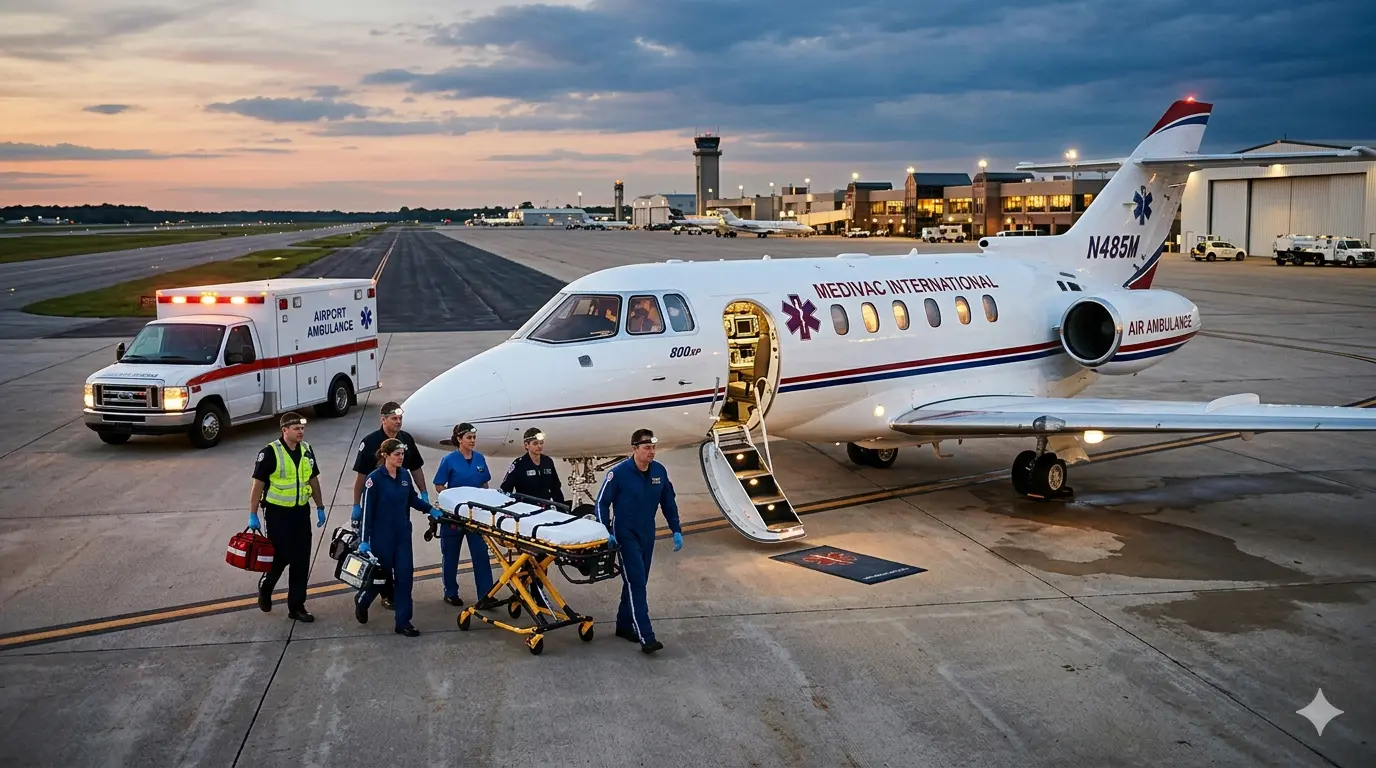
✈️ MEDICAL EVACUATION REALITY
Bali Medical Evacuation to Singapore: Process, Costs & Insurance Reality
When Bali’s hospitals reach their limit, Singapore is the standard escalation. Air ambulance + Mount Elizabeth or Raffles ICU + complex surgery = $80,000 to $200,000+. Without insurance, families wire 50% upfront before the plane lifts off. This guide breaks down exactly how the process works, what each component costs, which insurance actually covers it, and the mistakes that turn a medical event into a financial catastrophe.
📋 Response within 2 hours — no obligation
· Costs verified directly with air ambulance operators & Singapore hospitals
⚡ QUICK ANSWER
Bali → Singapore evacuation costs by complexity:
🟢 Commercial flight + medical escort: $15,000–$30,000
For stable patients who can fly commercial with a doctor or nurse escort. Specialized seating, oxygen if needed, no air ambulance required. The cheapest path when medically appropriate.
🟡 Standard medevac flight: $50,000–$80,000
Learjet or similar with medical configuration, 1 pilot + flight doctor + nurse, basic emergency equipment. Covers stable patients needing higher-level care than Bali offers. The most common Bali → Singapore evacuation tier.
🔴 ICU-grade medevac: $80,000–$120,000+
Larger aircraft with full ICU configuration, 2-doctor team, ventilator, advanced monitors. Required for unstable patients. Add Singapore ICU at SGD $4–10K/day plus surgery — total package easily $150,000–$300,000+.
Need evacuation coverage that actually pays? See insurance plans →
THE CAPABILITY GAP
Why Singapore Is Bali’s Standard Escalation Point
Bali’s main hospitals — BIMC Hospital and Siloam — handle most medical events foreigners encounter. Routine illness, scooter accidents with single fractures, dengue fever, food poisoning, even moderate surgery: all manageable locally. But Bali is, ultimately, an island in a developing country, and there’s a tier of medical care that simply isn’t available there. When that tier is needed, Singapore is the closest world-class destination.
What Bali can handle
BIMC and Siloam have Singapore-trained doctors, modern operating theaters, decent ICUs, English-speaking staff. They’re capable for: orthopedic surgery (broken bones with internal fixation), routine trauma stabilization, soft tissue surgery, dengue and other tropical illness inpatient care, basic neurosurgery (subdural hematoma evacuation), heart conditions requiring observation and standard intervention, infections requiring IV antibiotics. For all of these, evacuation isn’t justified — staying in Bali is faster, cheaper, and recovery-equivalent.
What Bali can’t handle
There’s a clear capability boundary where Singapore becomes the right answer. The list isn’t long, but each item is critical:
🧠 Complex neurosurgerySevere traumatic brain injury, complex aneurysm clipping or coiling, brain tumor resection requiring intraoperative imaging or specialized teams. Bali can do basic emergency neurosurgery; advanced cases need Mount Elizabeth or Raffles.🦴 Complex spinal surgerySpinal cord injury requiring decompression, multi-level spinal fusion, complex deformity correction. Singapore has dedicated spine units with intraoperative neuromonitoring; Bali doesn’t.🔥 Severe burn careMajor burns over 30% of body surface area, complex burn reconstruction, burn ICU with hydrotherapy and skin grafting protocols. Bali has burn capability but for specialized burn unit care, Singapore General Hospital or Raffles is the standard.🫀 Complex cardiac surgeryOpen-heart surgery, heart valve replacement, complex congenital heart correction. Bali can do basic cardiac care and stabilization; advanced cardiothoracic surgery is a Singapore strength.🩺 Multi-system traumaSevere accident victims with simultaneous brain injury, multiple organ damage, multiple fractures, hemodynamic instability. Need a Level 1 trauma center with immediate access to all surgical subspecialties — Bali doesn’t have a true Level 1 trauma facility.🦠 Specialized infection managementComplex sepsis with multiple organ failure, rare tropical infections requiring infectious disease subspecialty, antimicrobial-resistant infection requiring advanced antimicrobial protocols.
Why Singapore specifically?
Singapore is the obvious answer for three reasons. Distance: ~1,700 km / 1,050 miles from Bali, 3–4 hour flight by air ambulance. Other Asian medical hubs (Bangkok, Kuala Lumpur, Tokyo, Hong Kong) are either further or have less integrated international patient infrastructure. Quality: Mount Elizabeth Hospital, Raffles Hospital, Gleneagles and Singapore General Hospital are all world-class facilities with international patient services, English everywhere, and the equipment + specialists Bali lacks. Logistics: Seletar Airport in Singapore is configured for medical aviation with priority handling, and ground ambulances coordinate directly to the receiving hospital.
📌 The decision is medical, not logistical. The treating physicians at BIMC or Siloam initiate the evacuation request when the case exceeds local capability. Patients and families don’t choose to evacuate — the medical team determines it’s necessary. The insurer’s job (or family’s job, if uninsured) is to enable it logistically.
MEDICAL CRITERIA
When Evacuation Is Justified — and When It Isn’t
Insurance companies don’t approve evacuations on patient or family request alone. The treating doctor in Bali must document that local care is medically inadequate and that evacuation is in the patient’s best medical interest. Three criteria must be met simultaneously:
CRITERION 1Local care is inadequate for the caseThe treating doctor at BIMC or Siloam must document that the case requires capability beyond what local hospitals can provide. This isn’t a comfort or preference judgment — it’s a clinical determination based on the specific medical needs (specialized surgery, advanced ICU, subspecialty expertise) versus available resources.CRITERION 2Patient is medically transportableDespite needing higher-level care, the patient must be stable enough that air transport is itself safe. Patients in extreme cardiac instability, active major hemorrhage, or unstable airway issues sometimes can’t fly safely — they’re treated locally as best as possible until they stabilize enough for transport. Air ambulance medical teams perform pre-flight clearance evaluations.CRITERION 3Evacuation will materially change outcomeThere needs to be a meaningful clinical benefit to evacuation — better outcomes, faster recovery, access to definitive treatment that wouldn’t otherwise be available. Insurance companies push back on “comfort evacuations” where local care would have produced similar outcomes; medical justification needs to be specific to the case.
When evacuation is NOT justified
It’s worth being clear about cases that don’t qualify, because misunderstanding here causes friction with insurance:
- Routine surgery that BIMC or Siloam can perform competently (single fractures, appendectomy, gallbladder removal)
- Standard infections manageable with IV antibiotics in Bali
- Patient or family preference alone, without medical capability gap
- Convenience repatriation — wanting to recover at home rather than continuing recovery in Bali
- Cost-driven evacuation — wanting to leave Bali to escape mounting hospital bills
For these scenarios, insurance covers continued treatment in Bali but not evacuation. Some travel insurance plans include “repatriation home” benefits separate from evacuation — that’s a different process where the patient is stable enough to fly commercial after recovery, with an upgraded ticket if needed.
THE PROCESS
How a Bali → Singapore Evacuation Actually Unfolds
From the moment a Bali doctor decides evacuation is needed to the moment the patient arrives at Mount Elizabeth or Raffles, the process has 8 distinct stages. Each one has its own time pressure, decision points, and failure modes. Here’s how it actually plays out.
HOUR 0–2Stage 1: Medical determination at Bali hospitalThe treating physician at BIMC or Siloam evaluates the case, performs initial diagnostics (CT, MRI, blood work), and concludes that the case exceeds local capability. They issue a formal recommendation document explaining: clinical findings, specific capability gap, recommended destination (usually Singapore), urgency level (emergent vs urgent vs elective).HOUR 2–4Stage 2: Insurance contact and pre-authorizationThe insurance company’s 24/7 medical assistance team is contacted (either by the Bali hospital or by family). They review the recommendation, may request additional clinical information, may have their own consulting physician validate the medical necessity. If approved, they issue a Guarantee of Payment for the evacuation. If denied (rare for legitimate cases), the family must self-fund or appeal urgently.HOUR 4–8Stage 3: Air ambulance company is engagedThe insurer (or family, if self-funded) contacts an air ambulance operator. Multiple companies operate Bali ↔ Singapore: EMA Global, Medevac.Flights, Medical Air Service, Red Dot Air Ambulance, and others. They quote pricing, confirm aircraft availability, schedule the flight. For unstable patients, ICU-grade aircraft may need positioning from Singapore (~3–4 hours).HOUR 6–12Stage 4: Singapore receiving hospital coordinationIn parallel, the receiving hospital in Singapore (Mount Elizabeth, Raffles, Gleneagles or Singapore General) is contacted. They review the case, confirm acceptance, prepare the receiving team and bed (often ICU). The receiving hospital’s international patient services coordinator becomes the primary contact for the family throughout the transfer.HOUR 8–14Stage 5: Pre-flight stabilization & clearanceThe air ambulance medical team arrives at the Bali hospital, performs an in-person evaluation of the patient, may order final stabilization measures before flight (additional medications, fluid resuscitation, drainage tubes). They sign off on flight clearance. For unstable patients this stage takes longer; some patients require additional Bali hospital time to become flight-ready.HOUR 12–18Stage 6: Ground ambulance to Denpasar AirportPatient is transferred from BIMC/Siloam to Ngurah Rai International Airport (Denpasar / DPS) by ground ambulance with the air ambulance medical team accompanying. The aircraft is positioned for departure. Patient is loaded, equipment is verified, all documentation cleared with Indonesian customs and immigration (specialized handling for medical evacuations).HOUR 14–20 (3–4H FLIGHT)Stage 7: Flight Bali → Singapore Seletar Airport3–4 hour flight. Continuous medical monitoring, intervention as needed, communication with receiving hospital throughout. Most Bali → Singapore medical flights land at Seletar Airport rather than Changi — Seletar is configured for medical aviation with priority slots and direct ground ambulance access. Cabin altitude management can matter for patients with certain conditions (head injury, decompression).HOUR 18–22Stage 8: Ground ambulance to receiving hospitalFrom Seletar, ground ambulance to Mount Elizabeth, Raffles or Gleneagles (all in central or near-central Singapore, 30–60 minutes from Seletar depending on traffic). Receiving team takes over at hospital admission. Flight medical team handover is formal — clinical history, interventions during transport, current vital signs, all documented.
📌 Total elapsed time
From “evacuation needed” to “patient at Singapore hospital”: typically 18–24 hours for stable cases with proper insurance pre-authorization. Faster (12–14 hours) for absolute emergencies where everything is expedited. Longer (24–48 hours) if there’s insurance complications, family logistics, or aircraft positioning delays. The longer it takes, the more expensive — additional Bali hospital days at $500–$1,500/day plus crew standby costs.
AIR AMBULANCE OPERATORS
Companies Operating Bali ↔ Singapore Medical Flights
Several companies provide air ambulance services on the Bali ↔ Singapore route. In practice, the insurer (or assistance company) selects the operator — patients and families don’t shop around for air ambulance providers in real time. But knowing who actually operates these flights helps you understand the ecosystem and what coverage looks like.
SINGAPORE-ACCREDITED LEADEREMA GlobalSingapore’s only accredited air ambulance service provider. First fixed-wing air ambulance company in Asia to gain full EURAMI accreditation in Adult Critical Care and Advanced Critical Care. Pricing range USD $15,000–$200,000 depending on location, distance, and aircraft configuration. Used by major insurers and corporate medical assistance programs.BALI-FOCUSED OPERATORMEDEVAC.FLIGHTSSpecializes in medevacs from Bali to Australia, New Zealand, Singapore and beyond. Strong relationships with Bali hospitals (BIMC Kuta, BIMC Nusa Dua, BIMC Ubud, Siloam) and works directly with insurance companies and assistance providers. Bed-to-bed transportation services.INTERNATIONAL OPERATORMedical Air ServiceWorldwide operator with capacity to fly to/from Singapore Seletar Airport. Uses Learjet 35A and Cessna Citation Bravo aircraft with permanently installed ICU equipment. Available 24/7 for free non-binding quotes; can usually arrange medical repatriation within 2 days.SINGAPORE-BASED ICU SPECIALISTRed Dot Air AmbulanceSingapore-headquartered, fully owned aircraft including dual-stretcher configurations. ICU-level equipment with flight physicians, ICU-trained nurses, paramedics. Subsidiary of Seletar Jet Charter Group — direct ownership ensures regulatory consistency.ADDITIONAL OPERATORSAir Ambulance Singapore, JETBAY SOS, Horizon Air AmbulanceOther Singapore-based or international operators serving the Bali ↔ Singapore route. Insurance companies typically have preferred operator relationships, so the specific company on your case depends on your insurer’s network.
💡 What you should know
For insured patients, the choice of air ambulance operator is made by your insurer or their assistance company — they have negotiated rates and vetted operators. For uninsured patients self-funding, you can contact operators directly for quotes. EMA Global, Medical Air Service and Red Dot are the most accessible 24/7 contacts for direct inquiry. Most operators provide free non-binding quotes within hours.
REAL COSTS
Bali → Singapore Evacuation: Cost Breakdown
Total package costs vary enormously by complexity. Here’s how each component contributes to the final number, with 2026 pricing verified against air ambulance operators and Singapore hospital published rates.
Air ambulance flight component
$15,000 – $30,000🟢 Commercial flight + medical escortFor stable patients flying commercial with a medical escort (doctor or nurse). Specialized seating arrangement, oxygen if needed. Cheaper option when medically appropriate. Patient is essentially booked on a normal flight with extra services.$50,000 – $80,000🟡 Standard medevac flight (Learjet)Learjet 35A or Cessna Citation Bravo with medical configuration. 1 pilot + flight doctor + flight nurse. Basic emergency equipment, monitor, oxygen, medications. The most common Bali → Singapore evacuation tier for stable but inpatient-care-requiring cases.$80,000 – $120,000+🔴 ICU-grade medevacLarger aircraft with full ICU configuration. 2-doctor team, ICU-trained nurses, ventilator, advanced monitoring, intubation capability, vasopressor support. Required for unstable patients, head injury, severe respiratory failure, multi-organ involvement.
Singapore hospital costs (after arrival)
SGD $400 – $800/NIGHT (~USD $300–$600)🛏️ Standard private roomMount Elizabeth, Raffles, Gleneagles standard private rooms. Includes basic nursing, food, room services. Comparable to top-tier US private hospital pricing.SGD $4,000 – $10,000/DAY (~USD $3,000–$7,500)🏥 ICU per daySingapore ICU. Specialist team, full monitoring, ventilator, ICU nursing ratios. Daily rate. A typical Singapore ICU stay of 5–10 days alone runs $20,000–$75,000.SGD $30,000 – $80,000+ (~USD $22,000–$60,000)🧠 Complex neurosurgerySurgeon fees, anesthesia, OR time, post-op ICU. Severity-dependent. The most common reason cases are evacuated; the cost reflects the specialized capability not available in Bali.SGD $25,000 – $60,000 (~USD $18,000–$45,000)🦴 Major orthopedic / spine surgeryMulti-day inpatient, rehab planning, follow-up. Complex spinal cases, multi-level fusions, complex deformity correction.
Total package scenarios
$25,000 – $50,000Best case: Stable patient, commercial escort + minor surgeryCommercial flight with medical escort ($20K) + 3 days standard room + minor surgical procedure. Achievable when the case is stable and the surgery is less complex.$80,000 – $120,000Standard case: Medevac + 5 days ICU + surgeryStandard medevac flight ($60K) + 5 days ICU at SGD $5K/day ($25K USD) + complex surgical procedure ($35K) + standard rehabilitation. The most representative Bali → Singapore evacuation event.$150,000 – $300,000+Severe case: ICU medevac + 14 days ICU + neurosurgery + rehabICU-grade medevac ($110K) + 14 days Singapore ICU at SGD $7K/day ($75K USD) + complex neurosurgery ($60K) + extended rehabilitation ($30K). Severe trauma cases or complex multi-system illness routinely reach this range.
📊 The financial pattern: A Bali → Singapore evacuation event costs $80,000–$200,000 typically, $300,000+ in severe cases. Comprehensive travel insurance with proper evacuation coverage costs $50–$300/year. The math is simple: any insurance with $100K+ evacuation cover pays for itself 1,000 times over on a single event.
RECEIVING HOSPITALS
The Singapore Hospitals That Receive Bali Evacuations
Singapore has multiple world-class private hospitals capable of receiving evacuated patients. The choice depends on the medical case, your insurer’s network, and bed availability at the time. Here are the four main destinations.
PRIMARY DESTINATION🏥 Mount Elizabeth HospitalTwo facilities — Mount Elizabeth Orchard and Mount Elizabeth Novena. Among the most famous Asian medical destinations for international patients. Strong neurosurgery, cardiothoracic surgery, oncology. Dedicated international patient services with multi-lingual coordinators. The most common single destination for Bali evacuations.PRIMARY DESTINATION🏥 Raffles HospitalCentrally located in Singapore. Strong trauma, multi-disciplinary critical care, and post-acute rehabilitation. Particularly known for its integrated approach combining acute care and rehabilitation under one roof — useful when patients need extended recovery before flying home.SPECIALIZED CARE🏥 Gleneagles Hospital SingaporePart of the IHH Healthcare network (same as Mount Elizabeth). Particularly strong for orthopedic surgery, cardiology, and oncology. Receives a meaningful share of Bali evacuations involving complex orthopedic or spinal cases.PUBLIC HOSPITAL OPTION🏥 Singapore General Hospital (SGH)Singapore’s largest public hospital, also accepting international patients. Major teaching hospital with full subspecialty capability. Less expensive than the private alternatives but with longer wait times for non-emergency procedures. Particularly strong for complex burn care via Singapore General Hospital’s burn unit.
📌 You don’t choose the hospital
For insured patients, the destination hospital is decided by a combination of: your insurer’s network agreements, the medical case requirements, current bed availability, and the receiving team’s capability. Patients and families don’t shop hospitals during an emergency. For self-funded patients, you have more choice but in practice you still defer to the air ambulance operator’s recommendation based on case requirements.
WITHOUT INSURANCE
Self-Funded Evacuation: How It Actually Works
When evacuation is needed but you don’t have insurance covering it, the path is brutal but predictable. Here’s exactly what happens.
STEP 1Bali hospital tells you evacuation is neededTreating physician explains the case requires care beyond local capability. Recommends Singapore. International patient services at BIMC or Siloam can help coordinate but they don’t fund it. Ball is in your court.STEP 2Air ambulance company demands deposit before flightStandard practice: 50% of estimated cost paid before lift-off. For an $80,000 standard medevac, that’s $40,000 wired upfront. For an ICU-grade medevac, the deposit can be $50,000–$60,000. The plane will not depart Bali without confirmed funds. International wires from Western banks take 1–3 business days unless you can use specialized fast-transfer services.STEP 3Family scrambles to wire fundsThis is the hardest moment. Spouse, parents, siblings, sometimes friends are contacted. Banks are called, wire forms completed, transfer fees paid. Some travelers maintain “emergency credit” arrangements where their bank can wire under stress; most don’t. Crowdfunding (GoFundMe) sometimes plays a role for severe cases but takes days to mature, not hours.STEP 4Singapore hospital demands deposit before admissionMount Elizabeth, Raffles, Gleneagles all operate on the same payment-first model as private hospitals everywhere. They’ll need a deposit covering estimated costs — typically $30,000–$80,000+ depending on the expected length of stay and complexity. This is in addition to the air ambulance payment.STEP 5Treatment proceeds, costs accumulateOnce deposits are confirmed, treatment proceeds normally. The Singapore hospital tracks daily costs and asks for top-ups when costs approach the deposit. If you can’t top up, treatment can be modified — early discharge to less intensive care, scaled-back interventions. Decisions about your medical care become entangled with financial logistics.STEP 6Final reconciliation at dischargeWhen you’re medically cleared to leave Singapore, the final hospital bill is reconciled. Any remaining costs must be settled before discharge — additional wire transfers, credit card payments. Total typical out-of-pocket cost for a Bali → Singapore evacuation event: $100,000–$250,000, paid across multiple stages.
⚠️ The brutal truth without insurance
Self-funded evacuations work, but they’re financially devastating. A typical event will produce 2–3 wire transfers totaling $100K–$250K within 48–72 hours. Crowdfunding can recover some of this later but rarely covers it all. Many self-funded evacuation patients spend years paying off the medical loans afterward. The premium for proper insurance is a fraction of one wire transfer.
WITH INSURANCE
Insured Evacuation: How It Actually Works
With proper insurance, the same medical event creates a completely different financial experience. The medical care is identical; the family stress is dramatically reduced.
STEP 1Bali hospital initiates insurance contactBIMC or Siloam international patient services contacts your insurer’s 24/7 medical assistance line directly. The Bali doctor speaks with the insurer’s consulting physician about the case. Your role: provide policy number and confirm consent.STEP 2Insurer arranges everythingThe insurer (or their assistance company) coordinates: selects the air ambulance operator from their network, arranges flight scheduling, pre-authorizes the receiving Singapore hospital, handles all financial guarantees. Family doesn’t make wire transfers. Family doesn’t shop providers. Family focuses on the patient.STEP 3Air ambulance flies, hospital receivesThe flight happens, the patient arrives at Mount Elizabeth or Raffles, treatment proceeds. Behind the scenes, the insurer’s Guarantee of Payment is in place at every step. The hospital bills the insurer directly; you only handle your deductible (typically $50–$250 depending on plan).STEP 4Treatment continues without financial stressThroughout the Singapore stay, the insurer handles all financial coordination. Treatment is medically optimal (no early discharge for cost reasons, no scaled-back interventions). The patient and family focus on recovery. Length of stay is determined medically.STEP 5Discharge and repatriationWhen medically cleared, the insurer also typically covers the return flight home — including upgraded class if medically necessary (extra leg room for casts, business class for stretchers). Some plans include extended accommodation while you wait to be cleared for commercial flight.
✅ The reality with insurance
A Bali → Singapore evacuation with proper insurance means: $50–$250 deductible total out-of-pocket; no wire transfers under stress; no GoFundMe campaigns; medically optimal treatment, not financially constrained; family focuses on recovery, not on bills. The premium for this protection is $50–$300/year, depending on plan.
INSURANCE PLANS
Insurance Plans That Actually Cover Bali Evacuation
Not all travel insurance includes adequate evacuation cover. Some include token amounts ($25K–$50K) that don’t cover real Bali → Singapore events. Look for evacuation coverage of at least $100K–$1M, plus a 24/7 medical assistance team that actually arranges evacuations rather than just reimbursing afterward.
⭐ STRONGEST EVACUATION COVERGenki Traveler — from €52/month, varies by age (€1,000,000 total medical + evacuation included)€1,000,000 medical coverage applies to the entire event — including evacuation costs. No separate evacuation cap that limits coverage. Includes 24/7 emergency assistance that arranges evacuations directly. Underwritten by Squarelife. Also covers 125cc scooters without requiring a motorcycle license — relevant because scooter accidents are the leading evacuation trigger from Bali.FOR LONG-TERM RESIDENTSGenki Traveler — from €52/month, varies by age (worldwide nomad coverage)Genki’s nomad health insurance with comprehensive evacuation coverage. Designed for digital nomads and expats. Covers acute care and evacuation. Available for stays of 1–12 months, subscribable from abroad.DECENT EVACUATION COVERSafetyWing Complete — from $177.50/month ($1.5M medical, $100K evacuation)$100K specific evacuation cover, sufficient for most standard medevac flights. Combined with $1.5M total medical limit, covers typical Bali → Singapore events. Monthly subscription, cancel anytime. Requires valid motorcycle license + IDP for scooter coverage.FOR FAMILIES & SENIORSIMG Patriot Travel — Up to $1M evacuationStrong evacuation coverage included. Up to age 89 acceptance, family-friendly. Trip-based pricing — quote varies by age and trip length. Particularly suitable for older travelers, families, and those with pre-existing conditions.
⚠️ Plans to be cautious about
Some travel plans include “evacuation cover” that’s actually too low to be useful. Look carefully at: SafetyWing Essential ($250K medical, but limited evacuation), generic credit card travel insurance (often $25K-$50K evacuation cap), home country travel insurance for trips over 90 days. If the evacuation cap is below $100K, you’re partially exposed. If the policy excludes scooter accidents (most generic travel insurance does), you’re exposed to the most common evacuation trigger from Bali.
COMMON MISTAKES
5 Insurance Mistakes That Disable Evacuation Coverage
Even with insurance, these mistakes can leave you exposed to evacuation costs you thought were covered.
MISTAKE #1Self-organizing the evacuationSome patients (or panicked families) contact air ambulance companies directly and arrange evacuation without involving the insurer first. This is the #1 way to invalidate coverage. Insurance pays only for evacuations they pre-authorized through their network. Once you’ve contracted directly with an air ambulance company, the insurer typically won’t reimburse — you’ve gone outside the policy framework. Always call your insurer’s 24/7 line first.MISTAKE #2Choosing a plan with low evacuation limitsA real Bali → Singapore evacuation costs $80,000–$200,000+. Insurance with $25K or $50K evacuation caps only partially covers the event — you’re still exposed to $50K–$150K+ in costs. Look for evacuation cover of at least $100K, ideally $250K–$1M for serious cases.MISTAKE #3Not having scooter coverage when scooter is the triggerThe most common reason for Bali evacuation is severe motorbike trauma — head injury, multi-fracture, internal damage. If your insurance excludes motorbike accidents, the evacuation triggered by one is also excluded. Generic travel insurance excludes scooters by default; Genki Traveler is the rare option that covers 125cc scooters without requiring a motorcycle license.MISTAKE #4Insurance lapsed during visa extensionLong stays on B211A/C1 visa with multiple extensions — if your insurance ended at 60 days but you stayed 120 days, the second 60 days is uninsured. Any evacuation during that gap is paid out of pocket. Monthly subscription plans (Genki, SafetyWing) auto-continue; trip-based plans require manual extension.MISTAKE #5Pre-existing condition triggers evacuationIf a pre-existing condition (heart, diabetes, neurological) deteriorates and triggers evacuation, most travel insurance excludes the entire event. For known pre-existing conditions, declare them at policy purchase and choose plans that include pre-existing condition coverage (IMG Global Medical Insurance with pre-existing rider is the most flexible).
FAMILY LOGISTICS
Family Side of an Evacuation
Evacuations are stressful events for the whole family, not just the patient. Comprehensive insurance includes family-related benefits that significantly reduce the burden.
✈️ Family member visit benefitMost comprehensive plans include a “family member visit” benefit covering one round-trip flight + 5–10 nights of accommodation if you’re hospitalized in Singapore for over 5–7 days. Genki Traveler, IMG Patriot Travel, SafetyWing Complete all include some form of this.🏨 Accompanying patient (one parent for child)For pediatric patients, plans typically allow one parent to accompany the child during the air ambulance flight at no additional cost. For adult patients, having a family member accompany during transport is sometimes possible at the air ambulance company’s discretion (depends on aircraft size and patient stability).📞 Translation & communication supportInsurance assistance teams typically provide translation services and act as a single point of contact for the family — coordinating between Bali hospital, air ambulance, Singapore hospital, and the family. This dramatically reduces the cognitive load on the family during a stressful period.💔 Repatriation of remains (if worst case)In tragic cases where the patient doesn’t survive, comprehensive insurance covers repatriation of remains to home country — embalming, documentation (death certificate, repatriation certificate, embassy paperwork), special transport casket, customs clearance, air freight. Without insurance, this typically costs families an additional $10K–$20K on top of grief.
AFTERMATH
After the Evacuation: Recovery & Going Home
An evacuation doesn’t end when you arrive at Mount Elizabeth or Raffles. The recovery phase has its own logistics, costs, and insurance considerations.
Length of stay in Singapore
Typical evacuation events involve 5–14 days in Singapore for the acute phase (ICU, surgery, immediate post-op). Longer stays for complex cases. Your medical team determines when you’re stable enough to fly home. With proper insurance, this decision is medical, not financial — you stay until clinically appropriate.
Repatriation home
Once medically cleared, you fly home for continued recovery. Most insurance covers the return flight if your treating doctor in Singapore recommends it. For complex cases requiring special arrangements (extra seat for cast, business class for stretchers, doctor escort), additional costs may run $2,000–$8,000 — covered by comprehensive plans.
Continued recovery at home
Most evacuated patients require weeks or months of continued recovery at home. Travel insurance typically covers immediate post-discharge care for 30–60 days; longer-term recovery is usually picked up by your home country health system or your regular health insurance. For digital nomads without home-country health coverage, this transition can be tricky — Genki Traveler and IMG Global Medical Insurance bridge this gap by providing continued worldwide coverage.
📌 Recovery insights from survivors
Almost everyone who’s been through a Bali → Singapore evacuation says the same thing: even with full insurance, the experience is exhausting and life-changing. The financial protection of insurance lets you focus entirely on recovery — without it, the bills become a parallel crisis. Most evacuation survivors say they would never travel internationally again without comprehensive insurance with strong evacuation coverage.
FAQ
Bali Medical Evacuation: Frequently Asked Questions
How much does a Bali to Singapore medical evacuation actually cost?Air ambulance flight alone: $50,000–$120,000 typically (commercial escort option: $15K–$30K). Singapore hospital costs: $20K–$100K+ depending on length of stay and complexity. Total typical event: $80,000–$200,000. Severe cases with extended ICU and complex surgery routinely reach $200,000–$300,000+.Why Singapore specifically and not another nearby city?Singapore is the closest world-class medical destination from Bali (3–4 hour flight, ~1,700 km). Mount Elizabeth, Raffles, Gleneagles and Singapore General are all internationally accredited with English-speaking staff. Other Asian medical hubs are either farther (Tokyo, Hong Kong) or have less integrated international patient infrastructure (Bangkok, Kuala Lumpur). The combination of distance, quality, and logistics makes Singapore the standard.Who decides if I need to be evacuated?The treating physician at the Bali hospital (BIMC or Siloam) makes the medical determination based on case requirements vs local capability. Insurance company medical consultants typically validate the decision. Patients and families don’t choose to evacuate — the medical team determines necessity. Family preferences and patient wishes are considered but the primary criterion is medical capability gap.What’s the most common reason for Bali → Singapore evacuation?Severe motorbike trauma involving head injury and/or multi-system trauma is the leading cause. Bali has high tourist scooter accident rates and limited Level 1 trauma capability. Other common reasons: complex neurosurgery cases, severe burns, complex spinal injuries, certain cardiac conditions. Most evacuations are trauma-driven.How fast does an evacuation actually happen?Typical timeline from “evacuation needed” to “patient at Singapore hospital” is 18–24 hours for stable cases with proper insurance. Faster (12–14 hours) for absolute emergencies. Longer (24–48 hours) if complications. Aircraft positioning, insurance pre-authorization, pre-flight stabilization, ground logistics — each adds time but each is necessary.Can my family member fly with me on the air ambulance?Sometimes, yes, depending on aircraft capacity and patient stability. For pediatric patients, one parent typically accompanies. For adults, it’s case-by-case. Some plans include this seat free; others charge. Air ambulance companies confirm at booking. If not possible, family flies commercial separately and most insurance plans cover one round-trip flight as a “family visit” benefit.What if my insurance refuses to pay for the evacuation?Legitimate medical evacuations rarely get refused if they meet the three criteria (medical capability gap, transportable patient, materially better outcome). Most denials trace to: case didn’t actually require evacuation (BIMC could have handled it), policy exclusion (scooter without proper license), pre-existing condition not declared. If you face an inappropriate denial, file an appeal with detailed clinical documentation from the treating physician. Insurance ombudsman or financial regulator can mediate disputes.Should I just fly home instead of going to Singapore?For most acute cases, no. Bali → US/UK/Australia by air ambulance is far more expensive ($150K–$300K+ for the flight alone) and the patient may not be stable enough for that long flight. Singapore is closer, faster, and equivalent quality. After Singapore stabilization and acute treatment, repatriation home for continued recovery is the standard approach.Does evacuation insurance cover return flight home?Most comprehensive plans yes — repatriation home is a standard travel insurance benefit. Genki, SafetyWing Complete, IMG Patriot Travel all include this. Coverage extends to upgraded class if medically necessary (extra seat for casts, business class for stretchers, doctor escort). Get the recommendation in writing from the Singapore treating doctor and the insurance arranges the upgrade.What’s the minimum insurance limit I should have for evacuation cover?Look for evacuation coverage of at least $100,000, ideally $250,000–$1,000,000 for adequate protection. Plans with $25K or $50K caps are partial protection at best. Best options: Genki Traveler (€1,000,000 total medical including evacuation, no separate cap), IMG Patriot Travel (up to $1M evacuation), SafetyWing Complete ($100K specific evacuation). The premium difference between low-cap and adequate-cap plans is small relative to the protection it provides.
$200,000 Singapore Bill, or from €52/month Insurance?
A single Bali → Singapore evacuation costs more than four years of comprehensive insurance premium. The math has been the same for two decades. Genki Traveler from €52/month (varies by age) gets you €1,000,000 medical + evacuation + scooter cover.
Response within 2 hours · No spam, ever
📚 Sources & Methodology
Every cost figure, operator name, hospital reference and process detail is verified directly with air ambulance operators, Singapore hospitals, Bali hospitals (BIMC, Siloam) and insurance providers. We re-verify quarterly. Last full review: April 2026.
Air ambulance operators
- EMA Global — Singapore-accredited air ambulance, EURAMI ICU certification
- MEDEVAC.FLIGHTS — Bali-focused medevac operator
- Medical Air Service — international air ambulance
- Red Dot Air Ambulance — Singapore-based ICU specialist
- Air Ambulance Singapore, JETBAY SOS, Horizon Air Ambulance — additional operators
Hospitals
- BIMC Hospital — Kuta & Nusa Dua, Bali (origin hospital)
- Siloam Hospitals — Bali & nationwide
- Mount Elizabeth Hospital — Singapore primary destination
- Raffles Hospital — Singapore primary destination
- Gleneagles Hospital Singapore — orthopedic specialty destination
- Singapore General Hospital (SGH) — public hospital with full subspecialty
Insurance providers reviewed
- Genki (Traveler) — evacuation coverage and pricing verified
- SafetyWing (Essential & Complete) — evacuation cap and coverage verified
- IMG Global — Patriot Travel and Global Medical evacuation cover verified
How we verify
Process details cross-checked with air ambulance operator websites, Bali hospital international patient services, and Singapore hospital admission protocols. Cost figures verified against published quotes from operators and Singapore hospital pricing tables. Insurance terms read directly from official policy documents. We document weaknesses alongside strengths for every plan we cover. Read the full affiliate disclosure.